2025 Member Highlights
Provident10 is committed to helping our members thrive—today and in retirement. Explore this year's key achievements and how we delivered value for our members in 2025.
Explore the highlights

Provident10 is committed to helping our members thrive—today and in retirement. Explore this year's key achievements and how we delivered value for our members in 2025.
Explore the highlightsProvident10 is committed to helping our members thrive—today and in retirement. Explore this year's key achievements and how we delivered value for our members in 2025.
Explore the highlightsProvident10 is committed to helping our members thrive—today and in retirement. Explore this year's key achievements and how we delivered value for our members in 2025.
Explore the highlights
When planning for your retirement, there’s a lot to consider. Having different income streams, age thresholds, and eligibilities, all impact your pension. Understanding how different programs work together is incredibly important for making informed decisions about your finances and feeling confident in your retirement. In this blog, we review the different workplace and government pension programs, and how PSPP fits into your overall retirement plan as a Provident10 member.
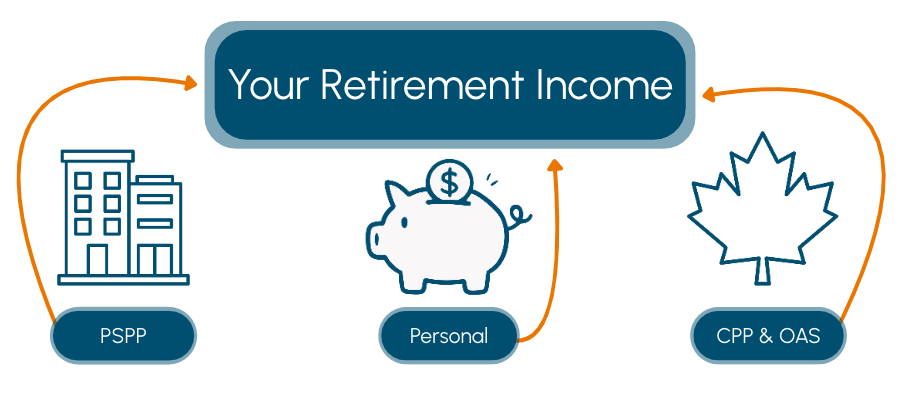
For most Provident10 members, retirement income has three main sources:
1. Workplace sponsored: Public Service Pension Plan (PSPP)
2. Government sponsored: Canada Pension Plan (CPP) and Old Age Security (OAS)
3. Individually sponsored: Registered Retirement Savings Plan (RRSP), Tax Free Savings Account (TFSA), or other investments.
The Public Service Pension Plan (PSPP) is Provident10’s Defined Benefit (DB) pension plan. PSPP pension benefits are secure and paid for the rest of your life.
PSPP is integrated with the CPP. This is important to note because eligible members who retire before age 65 will receive a temporary Bridge Benefit, which is payable until age 65 (keep reading to learn more about the Bridge Benefit).
Plan members and participating employers contribute equally to the PSPP fund, and these contributions are invested and managed by Provident10’s investment professionals to generate investment income to support the plan’s benefits.
You can find an in-depth plan overview in the Member Handbook.
To receive your PSPP pension, you must:
1. Be vested in the Plan
2. Meet the age and service requirements for retirement
3. Be retiring from full-time employment with a participating employer
PSPP is a Defined Benefit plan, meaning Provident10 uses a formula for calculating your pension. The formula is:
2% of your Highest Average Earnings (HAE) x Years and Months of Credited Service.
You can use Provident10’s pension calculator to get an estimate of your pension earnings.
The Canada Pension Plan (CPP) is an earnings-based, retirement income program. CPP is indexed and adjusted annually in January. CPP is funded by contributions from people employed in Canada (excluding Quebec), their employers, and the revenue earned from investments. From age 18, if your total annual earnings are above $3,500, CPP contributions are mandatory, however you can opt-out of contributing to CPP after age 65.
CPP is managed by the federal government in collaboration with the provinces. If you’re eligible, you’ll receive CPP benefits for the rest of your life.
To receive your CPP pension, you must:
1. Be between 60 and 70 years old:
2. Have made a valid contribution to the CPP.
3. Have submitted an application to Service Canada. You can apply online on the Government of Canada website.
The CPP is an earnings-based benefit, meaning what you receive is based on your contributions.
Your benefit is impacted by:
You can get a your CPP estimate using your My Service Canada Account (MSCA).
Old Age Security (OAS) is a pension program funded by the Government of Canada through tax revenues (not employment contributions like PSPP or CPP). OAS is indexed quarterly to reflect increases in the cost of living.
You’ll be automatically enrolled in OAS and Service Canada will inform you of your enrollment by mail, however if you don’t receive confirmation of your enrollment, you may need to apply.
If you’re eligible and begin receiving OAS at age 65, your pension payments will generally start the month after your 65th birthday. You can also choose to delay your OAS pension to receive a higher monthly amount later. If you’re eligible, you’ll receive OAS benefits for the rest of your life.
To receive your OAS pension, you must:
1. Be 65 years old.
2. Spent time living in Canada after age 18.
3. You submit a tax return each year.
Your OAS pension is calculated on:
You can estimate your OAS pension by using the OAS Benefits Estimator.
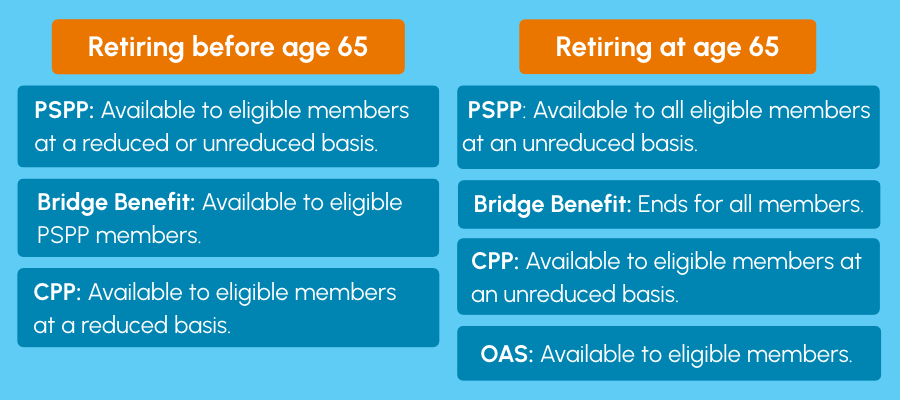
The Bridge Benefit is a temporary, extra pension payment for PSPP members that retire early.
As PSPP is integrated with CPP from a pension contribution perspective, the Bridge Benefit exists to close the gap in income until you reach age 65 (when you become eligible to receive your unreduced CPP pension).
Bridge benefit eligibility:
The Bridge Benefits ends at age 65 because PSPP is coordinated with CPP. When you reach age 65, you become eligible for your unreduced CPP pension, regardless of when you started receiving CPP benefits. In other words, the Bridge Benefit ends because there is no longer a gap in income after age 65.
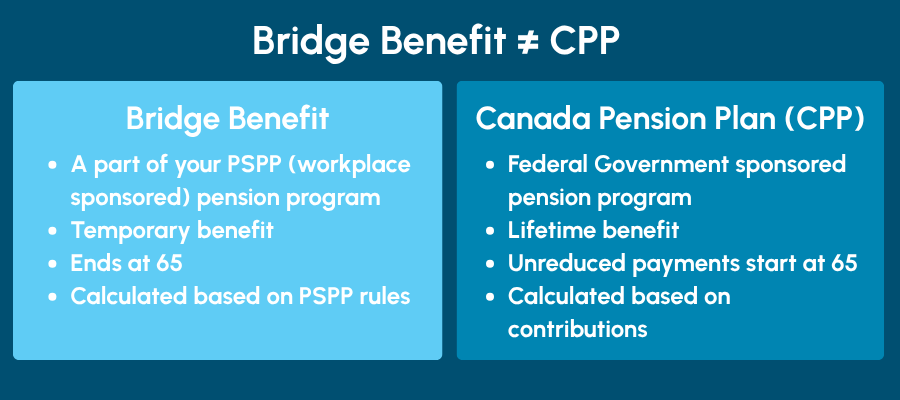
The Bridge Benefit and CPP are not equal.
Your CPP entitlement is based on contribution history, while the Bridge Benefit is calculated under PSPP rules.
The Bridge Benefit is based on the lesser of your highest average earnings (HAE) or the average of the year’s maximum pensionable earnings (YMPE) for the 36 months before the month you retire. The formula used to determine your Bridge Benefit is:
0.6% x HAE (or three-year average of YMPE) x number of years of service*
*The maximum number of years of service used to determine your bridge benefit is 35 years.
Taking CPP early or later doesn’t change when the Bridge Benefit ends. The Bridge Benefit ends at age 65 for everyone.
Planning for your retirement looks a little different for everyone, but we hope this blog shed some light on the different pension programs PSPP members may be eligible for.
No matter your proximity to retirement, some key considerations to think about are:
If you are a PSPP member planning to retire in the next six to 12 months, congratulations! Provident10 offers Retirement Ready virtual sessions to help members feel confident in their retirement journey. You can find and register for upcoming sessions on the Members Information Sessions page.
About Provident10
Since 2017, Provident10 has been serving the public service employees of Newfoundland and Labrador. At more than 68,000 members (and growing), we are one of the largest public service pension plans in Atlantic Canada.
We deliver plan administration services and oversee management of the Public Service Pension Plan investment portfolio with one goal in mind: protecting the financial health of the Plan and helping Plan members navigate their pension journey.