2025 Member Highlights
Provident10 is committed to helping our members thrive—today and in retirement. Explore this year's key achievements and how we delivered value for our members in 2025.
Explore the highlights

Provident10 is committed to helping our members thrive—today and in retirement. Explore this year's key achievements and how we delivered value for our members in 2025.
Explore the highlightsProvident10 is committed to helping our members thrive—today and in retirement. Explore this year's key achievements and how we delivered value for our members in 2025.
Explore the highlightsProvident10 is committed to helping our members thrive—today and in retirement. Explore this year's key achievements and how we delivered value for our members in 2025.
Explore the highlights
Hugo, Member
We invest with a long-term perspective — one that’s grounded in thoughtful decision making, diversification, and prudent risk management rather than short-term market timing.
The current mix includes four key areas, which is reassessed every three to five years to ensure it remains aligned with the Plan’s Funding Policy and investment goals.
Our investment team leverages its combined domestic and international expertise, overseeing a strategy that’s built on a well-diversified portfolio of investments that will deliver the best risk-adjusted returns — the key to long-term investment success.
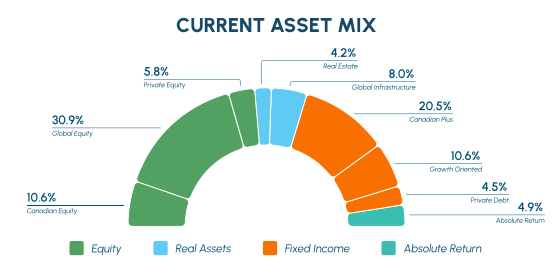
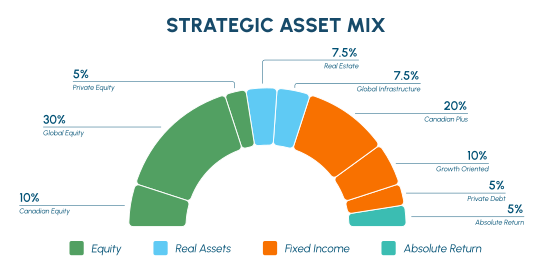
The current mix includes four key areas:
Also known as stocks, these can be shares of a publicly traded company — something you would see listed on an exchange or investments in private equity.
Equity is often seen as more volatile and typically carries greater risk, but has the potential to deliver stronger performance over a long-term period.
Real assets are investments like real estate and infrastructure. Since these are tangible assets, they’re typically also a longer-term investment.
Real assets can offer strong risk-adjusted returns and often respond to the market differently relative to asset classes like stocks.
Fixed income includes bonds and other debt instruments — investments that generate returns in the form of interest.
Fixed income typically seen as lower risk than equities, as they can be more predictable in their returns.
Absolute return is an asset class that focuses on delivering a positive return over time, regardless of how the broader market performs.
Absolute return can include a number of different investment types to diversify, manage risk and deliver an absolute return.
We use a thorough and rigorous risk-controlled approach by choosing an optimized risk level within a multi-year framework and by selecting and weighting asset classes to achieve a target return. By identifying an acceptable risk threshold, we can determine the mix of assets with the best chance to achieve its goal.
The Plan’s strategic asset mix policy was established based on an asset-liability analysis that took into consideration the Plan’s liabilities, the Board’s risk tolerance and the long-term return requirements.
Since 2015, we have led the transformation and financial management of the Fund — improving the overall health of the pension plan in that timeframe.
The PSPP Funding Policy is designed to guide the Plan towards maintaining its fully funded status.
*The promissory note (currently 20% of the total net assets of the Fund) provides steady cashflow and liquidity to the Fund, which is beneficial in providing stability to the funded status.

The funding policy lays out defined thresholds that must be met before implementation of any Plan improvements are allowed and identifies whether changes are required to improve Plan funding.
In consultation with the Investment Committee, our Board of Directors documents the investment policies for the Public Service Pension Plan Fund in the Statement of Investment Policies and Procedures (SIP&P).
The SIP&P provides a means for the Board and the Investment Team to measure and monitor the performance of the Fund against its stated objectives. It addresses key matters including the Fund governance, investment objectives and beliefs, philosophy, asset mix policy, risk management, permitted types of investments, and the responsible investing strategy.
 GET AN
ESTIMATE WITH
OUR PENSION
CALCULATOR
GET AN
ESTIMATE WITH
OUR PENSION
CALCULATOR SUBSCRIBE
  HAVE
QUESTIONS?
GET IN TOUCH! CONTACT US
HAVE
QUESTIONS?
GET IN TOUCH! CONTACT US